

Artificial Intelligence is no longer limited to large technology companies. Today, small businesses can also use AI to automate repetitive tasks, improve customer communication, save time, and operate more efficiently.
From answering customer questions to generating content and managing leads, AI can help businesses handle many everyday activities with less manual effort.
For a small business owner, this can mean spending less time on repetitive work and more time focusing on customers, sales, and business growth.
What Is AI Automation for Small Businesses?
AI automation means using artificial intelligence-powered software to perform tasks that would normally require manual effort.
For example, instead of an employee answering the same customer questions repeatedly, an AI chatbot can provide instant answers.
Similarly, AI can help businesses:
- Respond to customer enquiries
- Qualify leads
- Generate content
- Analyze business data
- Automate emails
- Schedule appointments
- Summarize documents
- Manage repetitive administrative tasks
- Provide personalized customer experiences
The goal isn’t necessarily to replace people. The goal is to help people work faster and more efficiently.
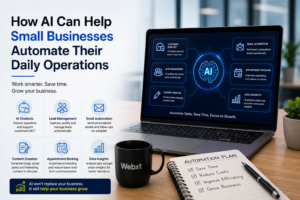
Why Should Small Businesses Use AI?
Small businesses often operate with limited employees and resources.
An owner may have to manage marketing, customer support, sales, operations, accounting, and administration at the same time.
AI can help reduce the amount of repetitive work involved in these activities.
1. Automate Customer Support
Customer support is one of the easiest areas where businesses can start using AI.
An AI-powered chatbot can answer common questions such as:
- What are your working hours?
- What services do you provide?
- Where are you located?
- How can I book an appointment?
- What is the price of your service?
- How can I contact your team?
Customers can receive answers instantly without waiting for an employee.
For more complex questions, the system can forward the conversation to a human team member.
2. Generate and Manage Leads
Getting leads is important, but managing them manually can become difficult as the business grows.
AI can help businesses collect information from website visitors and determine which enquiries are more likely to become customers.
For example, an AI-powered system can ask visitors about:
- Their requirements
- Their budget
- Their preferred service
- Their location
- Their expected timeline
The collected information can then be organized for the sales team.
This allows employees to spend more time talking to high-quality prospects instead of manually sorting every enquiry.
3. Automate Email Communication
Businesses often send similar emails repeatedly.
Examples include:
- Welcome emails
- Appointment confirmations
- Follow-up emails
- Order updates
- Enquiry responses
- Feedback requests
AI automation can help create personalized responses based on the customer’s requirements.
This can make communication faster while maintaining a professional customer experience.
4. Create Marketing Content Faster
Creating content consistently can be difficult for small businesses.
AI can assist with:
- Blog ideas
- Social media captions
- Product descriptions
- Email campaigns
- Advertisement copy
- Website content
- Marketing ideas
However, AI-generated content should still be reviewed and improved by humans to ensure that it accurately represents the business and its brand voice.
5. AI-Powered Website Experiences
A traditional website mostly provides information.
An AI-powered website can go a step further by interacting with visitors.
For example, an AI assistant on a business website could help visitors:
Find a service → Ask questions → Share requirements → Get recommendations → Submit an enquiry
This creates a more interactive experience and can potentially increase conversions.
6. Automate Appointment Booking
Businesses that depend on appointments can also benefit from AI automation.
Instead of manually responding to messages like:
“Is tomorrow afternoon available?”
an automated system can check availability and guide customers through the booking process.
This can be useful for:
- Clinics
- Salons
- Consultants
- Fitness businesses
- Agencies
- Real estate companies
- Professional services
Automation can reduce unnecessary back-and-forth communication.
7. Analyze Business Data
AI can also help business owners understand their data.
For example, an AI system can analyze:
- Sales data
- Customer behaviour
- Website traffic
- Marketing performance
- Lead sources
- Product performance
Instead of looking through large spreadsheets manually, business owners can use AI to identify patterns and important insights.
8. Reduce Repetitive Administrative Work
Many business processes involve repetitive tasks.
AI automation can help with activities such as:
- Data entry
- Document summarization
- Report generation
- Invoice processing
- Internal communication
- Task organization
- Information extraction
Even saving a few hours every week can make a significant difference for a small business.
How Much Does AI Automation Cost?
The cost depends heavily on what you want to automate.
A simple AI chatbot can be relatively affordable, while a completely custom AI-powered business platform may require significantly more development.
The cost can depend on:
- AI model/API usage
- Number of users
- Custom development
- Integrations
- Database requirements
- Dashboard requirements
- Automation complexity
- Hosting
- Ongoing maintenance
The best approach is to identify the specific business problem first and then choose the appropriate AI solution.
Should Every Small Business Use AI?
Not necessarily.
AI is useful when it solves a real problem.
If a process takes only a few minutes per week, building an expensive automation system may not make sense.
However, if your team spends hours every day answering repetitive questions, processing leads, creating reports, or performing administrative tasks, automation can provide significant value.
The key question shouldn’t be:
“Where can we use AI?”
Instead, ask:
“Which repetitive business problem can AI solve for us?”
How Webxt Can Help
At Webxt, AI can be integrated into websites, web applications, and business workflows to create practical solutions tailored to specific business requirements.
Whether it’s an AI chatbot, automated lead qualification, intelligent search, content automation, or a completely custom AI-powered application, the technology should be designed around the actual needs of the business.
The objective is simple:
Use AI to save time, improve efficiency, and create better digital experiences.
Final Thoughts
AI automation is becoming increasingly accessible to small businesses.
You don’t need to build a complicated AI system from day one. Start with one repetitive process that consumes significant time and explore whether automation can make it faster and easier.
As the business grows, additional AI-powered workflows can be introduced gradually.
The businesses that use AI effectively won’t necessarily be the ones using the most advanced technology. They will be the ones that use technology to solve the right problems.